Why Most Companies Miss Out on Subsidies (and How You Can Avoid It)
Let’s get something straight. Government subsidies aren’t free money. They’re reimbursements tied to investments or performance. If your project doesn’t meet the criteria — no matter how great your idea is — you’re not getting a single rupee.
But here’s the real problem: many companies don’t even know what they’re eligible for. Worse, they assume they can only apply for either a Central scheme or a State policy. That’s like walking away from half the pot. You’re leaving serious money on the table.
Let me explain how it actually works — with a simple example.
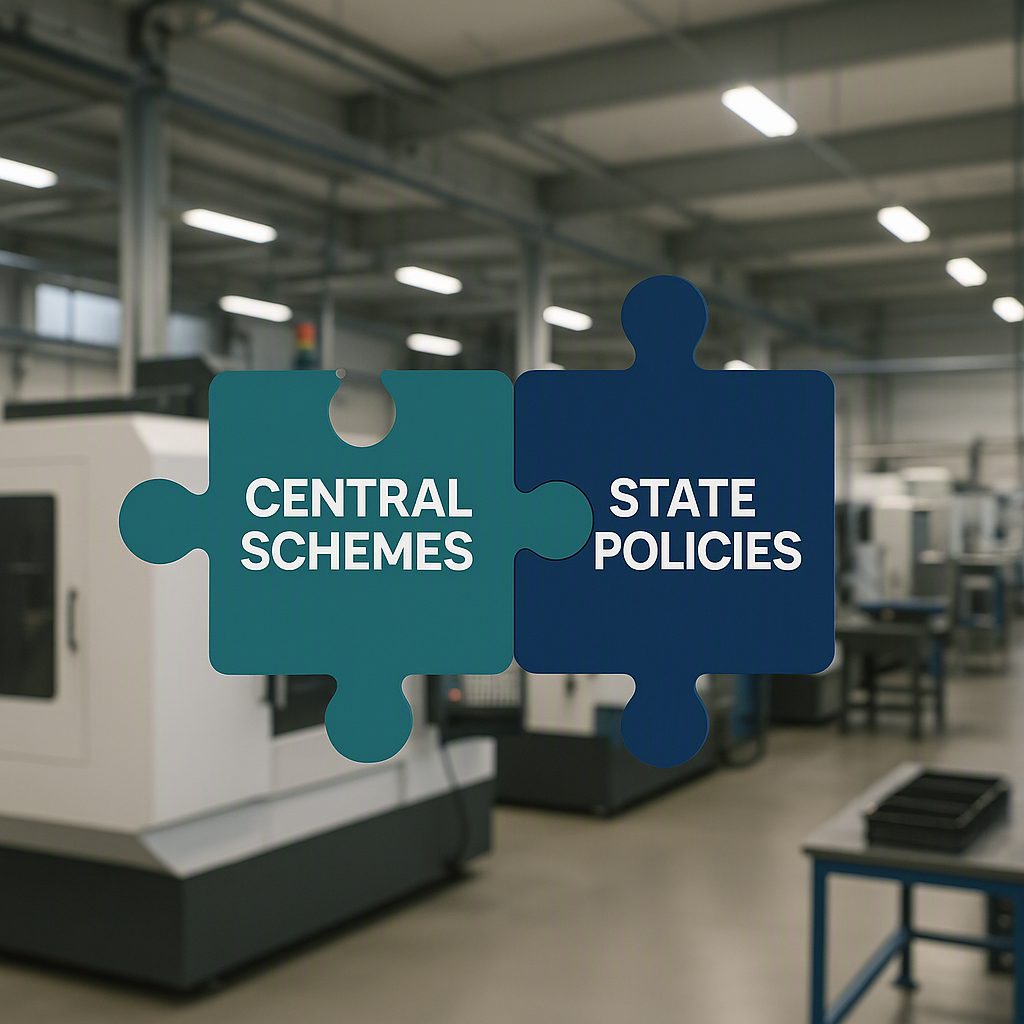
The Two Layers: Central Schemes and State Policies
Every eligible project in India can potentially benefit from both a Central government scheme and a State industrial policy. Think of it as two layers of incentives, each with its own rules, timelines, and benefits. But here’s the catch: you can’t just stack them blindly. You need to know which combinations work, which don’t, and what each layer actually covers.
Central Government Schemes
Run by Union ministries, these schemes target specific industries or objectives. Here are some of the most prominent ones:
-
Production Linked Incentive (PLI) Scheme: This scheme incentivizes incremental sales of eligible products across sectors like electronics, pharmaceuticals, and textiles. The incentives are significant, but so are the eligibility requirements. Companies must meet minimum investment thresholds, ensure domestic value addition, and, in some cases, commit to export obligations. This means you need a clear capital plan and operational strategy before even applying.
-
Design Linked Incentive (DLI) Scheme: Geared toward electronics and semiconductor innovation, this scheme funds up to 50% of R&D costs for eligible projects. However, the bar is high — applicants must demonstrate both technical feasibility and financial stability. A robust business case is essential here.
-
Export Promotion Capital Goods (EPCG) Scheme: This scheme allows import duty exemptions on machinery needed for production, provided the company fulfills certain export obligations. While this can reduce up-front costs, it also locks you into a commitment to meet export targets within a specified timeframe.
Central schemes are uniform across the country, offering the same benefits regardless of your location. However, they often involve extensive paperwork, adherence to strict timelines, and ongoing compliance requirements. Missing even one criterion can disqualify you.
State Industrial Policies
State governments also offer lucrative incentives, but these vary significantly depending on geography, industry, and unit size. Here are some examples:
-
Maharashtra’s Package Scheme of Incentives (PSI): This scheme provides capital subsidies, SGST refunds, and electricity duty exemptions. The benefits are tiered — projects located in backward talukas receive higher incentives, which means your location decision can directly impact your subsidy amount.
-
Gujarat Industrial Policy: Focused on mega and ultra-mega projects, this policy offers interest subsidies, stamp duty exemptions, and even R&D support. It’s particularly attractive for large-scale manufacturing units.
-
Tamil Nadu Electronics Hardware Manufacturing Policy: Tailored for the electronics sector, this policy provides capital subsidies of up to 40% for eligible projects. If you’re in electronics, Tamil Nadu is one of the most subsidy-friendly states for setting up operations.
Unlike Central schemes, State policies are highly localized. Some states also offer special incentives for backward or underdeveloped regions. However, the flip side is that rules and benefits can differ widely from state to state, adding another layer of complexity.
The Real Challenge: Understanding Eligibility and Stacking
Here’s where things get tricky. Central schemes and State policies often overlap, but they’re not always designed to work together. For example, if you’re applying for the PLI scheme for electronics, you might also be eligible for SGST refunds under your State’s industrial policy. But here’s the kicker: some State policies explicitly exclude projects already availing Central incentives. Others require you to cap your total subsidy claims.
This creates a maze of rules and exceptions. And if you’re not careful, you might:
- Apply for conflicting schemes and get disqualified from both.
- Miss critical deadlines because you didn’t realize how long the Central scheme’s approval process takes.
- Submit incomplete or incorrect documentation, delaying disbursement (or worse, triggering rejection).
To navigate this maze, you need to:
- Understand the fine print: Read the detailed guidelines of every scheme you’re eligible for. Pay special attention to exclusions and requirements for combining schemes.
- Plan your application timeline: Many schemes have strict deadlines, and missing even one can disqualify you. This is particularly important if one scheme’s approval is a prerequisite for another.
- Prepare a watertight DPR (Detailed Project Report): A comprehensive DPR is non-negotiable. It should include your financial projections, project timelines, technical details, and all supporting documents.
A Practical Example: Combining PLI with State Subsidies
Let’s say you’re setting up a manufacturing unit for electronics in Maharashtra. You’ve already decided to apply for the PLI scheme. Good choice — you’ll get incentives based on your incremental sales. But that’s just the Central layer. What about the State?
Under Maharashtra’s PSI, you could be eligible for:
- A capital subsidy of up to 40% for investments in machinery.
- Power tariff subsidies for the first five years of operation.
- SGST refunds on goods sold within the state.
Here’s how to structure your approach:
- Check for overlap: Maharashtra’s PSI allows you to claim SGST refunds alongside the PLI scheme, but only if your project is located in a designated “D” zone. This means your plant’s location becomes a critical decision factor.
- Align your timelines: PLI applications typically have a fixed window, while PSI applications are tied to project milestones. Plan your project kickoff and investment phases to meet both sets of deadlines.
- Document meticulously: Both schemes require detailed financial and technical documentation. Missing even a single supporting document can delay or derail your application.
By carefully aligning these steps, you can significantly reduce your project costs.
Common Mistakes (and How to Avoid Them)
-
Assuming You’re Not Eligible: Many companies dismiss subsidies as “too complicated” or assume they don’t qualify. Don’t guess. Get a professional assessment.
-
Missing Deadlines: Central schemes often have limited application windows. State policies, on the other hand, might tie deadlines to specific project milestones. Track both carefully.
-
Poor Documentation: A half-baked DPR or missing compliance certificates can derail your application. Invest the time (or hire experts) to get it right.
-
Ignoring Scheme Stacking Rules: Not all combinations work. Check the fine print to ensure you’re not violating any conditions.
Comparison Table: Central vs State Schemes
| Aspect | Central Schemes | State Policies |
|---|---|---|
| Uniformity | Same benefits across India | Varies by state |
| Primary Focus | Sector-specific objectives | Regional investments |
| Examples | PLI, DLI, EPCG | PSI (Maharashtra), Gujarat Policy |
| Documentation Required | Extensive | Moderate to extensive |
| Deadlines and Timelines | Fixed application windows | Tied to project milestones |
What You Can Do Now
If you’re planning a new project or expansion, start by mapping your eligibility. Look at your sector, location, and investment size. Identify both Central and State schemes that apply. Then, dig into the details: what’s covered, what’s excluded, and what the deadlines are.
And remember, this isn’t a one-time process. Policies change. A scheme that doesn’t work today might be a perfect fit next year. Stay updated, or better yet, work with someone who monitors these changes for you.
Need Help?
Navigating India’s subsidy landscape is complex, but you don’t have to do it alone. If you’re dealing with eligibility confusion or missed opportunities, Subsidy4India can help. Get started →