
India has taken a giant leap in its semiconductor ambitions with the Union Cabinet approving India Semiconductor Mission 2.0 (ISM 2.0) — the next phase of the country’s flagship chip manufacturing initiative — with a massive outlay of ₹1.27 lakh crore. Unveiled in the Union Budget 2026-27, ISM 2.0 signals India’s shift from subsidy-led attraction to building a sustainable, self-reliant semiconductor ecosystem.
What is the India Semiconductor Mission (ISM)?
The India Semiconductor Mission (ISM) is a Government of India initiative under the Ministry of Electronics and Information Technology (MeitY) aimed at positioning India as a global hub for semiconductor and display manufacturing. ISM 1.0 approved 13 semiconductor projects across seven states, including logic/power fabs, OSAT/ATMP units, and silicon carbide and substrate-focused projects.
ISM 2.0 goes further — expanding full-stack design capabilities, promoting indigenous intellectual property (IP), and strengthening supply chain resilience across the semiconductor value chain.
Key Features of ISM 2.0
- Total outlay of ₹1.27 lakh crore approved by Union Cabinet
- Tightened subsidy rules — chipmakers and states must bear a larger share of project costs
- State governments expected to provide land and local infrastructure
- Focus on financially strong, technologically capable investors over subsidy-driven proposals
- Expansion of full-stack chip design capabilities and indigenous IP
- EDA tools from Synopsys, Cadence, Siemens, Renesas, Ansys, and AMD now accessible in 315 educational institutions nationwide
Financial Incentives Available
| Incentive Type | Details |
|---|---|
| Capital Subsidy (Central) | Up to 50% of project cost for Fabs, Compound Semiconductors, ATMP/OSAT facilities |
| Design Linked Incentive (DLI) | Up to 50% reimbursement of design costs (capped) for fabless/chip design companies |
| Interest Subsidy | 5% per annum on loans up to ₹200 Crore for 7 years (state-level) |
| SGST Waiver | Complete waiver of net State GST for up to 10 years |
| Land Subsidy | Up to 75% subsidy on land purchase (state-level, e.g. Gujarat’s Dholera Semicon City) |
| Stamp Duty & Registration | 100% exemption |
| Electricity Duty | 100% exemption for up to 10 years |
| R&D & Patent Support | Subsidies for R&D centres, CoE setup; up to ₹20 Lakhs reimbursement for international patents |
| Employee Cost Reimbursement | Reimbursement of certain employee-related expenses for qualified manufacturers |
Who Can Apply?
- Semiconductor Fabs (Logic, Power, Silicon Carbide)
- Display Fabs
- Compound Semiconductor Units
- ATMP / OSAT Facilities (Assembly, Testing, Marking & Packaging / Outsourced Semiconductor Assembly and Test)
- Fabless Chip Design Companies (under Design Linked Incentive scheme)
- R&D Centres and Centres of Excellence
- Projects approved under ISM schemes and state-level ESDM policies
Note: Projects are selected based on investment thresholds, revenue criteria, technology type, and manufacturing capacity as per scheme guidelines.
How is the Subsidy Disbursed?
- Subsidies are disbursed on a pari-passu basis — payments are made in instalments as the project progresses
- Funds are deposited into a No-Lien Account (NLA) to ensure proper utilisation
- First instalment released after the beneficiary mobilises its share of funding
- Subsequent instalments made upon submission of project progress reports
- Beneficiaries must submit Quarterly Review Reports (QRRs) and maintain production for at least 3 years
- Entire project must be operational within 6 years of approval
State-Level Incentives
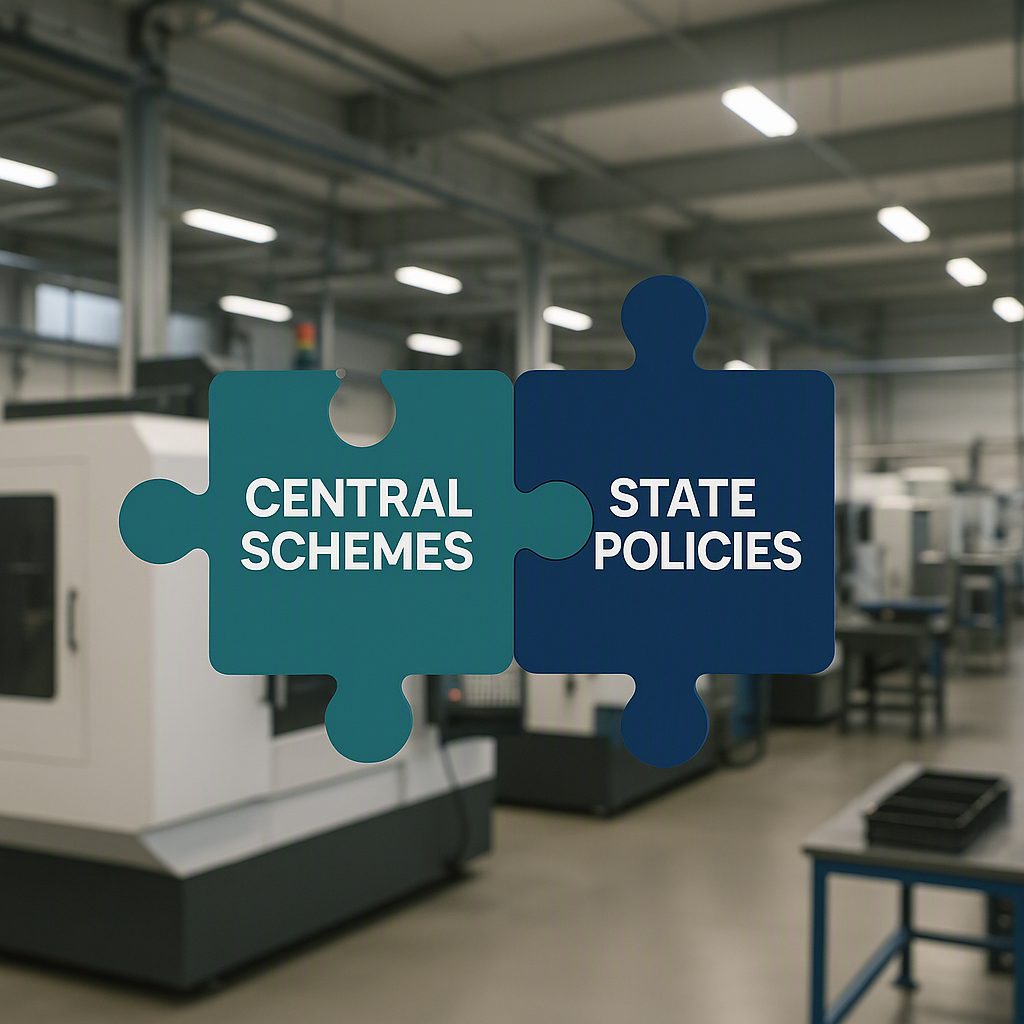
States are layering their own incentive packages on top of the central government’s ISM support:
- Gujarat – Dholera Semicon City: 75% land subsidy, power tariff subsidy of ₹2/unit for 10 years, free electricity duty, water at ₹12/cubic metre for 5 years
- Karnataka – ESDM Policy: 10% capital subsidy, R&D grants, patent reimbursements, stamp duty exemption, power tariff discounts
- Uttar Pradesh – UP IT/ITeS Policy: 50% capital subsidy (matching central), 5% interest subsidy, 75% land rebate, 100% stamp duty exemption, 100% electricity duty exemption for 10 years
Why India and Why Now?
The global semiconductor supply chain is being restructured — and India is perfectly positioned to capture a significant share. With a large engineering talent pool, growing domestic demand, government backing at both central and state levels, and strategic geopolitical positioning as a trusted chip supplier, India is ticking all the right boxes for semiconductor investment.
ISM 2.0’s focus on quality over quantity — prioritising technologically capable and financially strong investors — signals that India is building for the long term, not just chasing announcements.
How Subsidy4India Can Help
Navigating ISM 2.0, DLI, SPECS, and state-level semiconductor incentives requires deep expertise in government scheme applications. Subsidy4India helps semiconductor companies, chip designers, ATMP units, and electronics manufacturers:
- Assess eligibility under ISM 2.0, DLI, and SPECS schemes
- Prepare and submit strong project proposals
- Navigate state-level incentive applications in Gujarat, Karnataka, UP, and beyond
- Manage compliance, QRR submissions, and disbursement tracking
 Contact Subsidy4India today to know how your semiconductor business can benefit from India’s ₹1.27 lakh crore chip mission.
Sources: India Semiconductor Mission (MeitY), Outlook India, India Briefing, Cyril Amarchand Blogs