
Think Subsidies Are Free Money? Think Again.
A lot of companies, especially first-time applicants, think subsidies are just free money handed out by the government. But here’s the truth: subsidies in India are reimbursements. You don’t just get a cheque because you have a great idea or a promising business plan. You need to spend money first—on land, buildings, plant, machinery, or other eligible costs—and then prove it. No proof? No money.
For MSMEs, subsidies might also cover things like intellectual property (IP) filing or quality certifications. For larger enterprises, they can include tax refunds or incentives on incremental production. It’s not cash upfront. It’s about getting some of your investment reimbursed after you’ve fulfilled all the terms of the scheme. And trust us, those terms can get tricky.
Why Hire a Government Subsidy Consultant in India?
Here’s the next misconception: “We’ll just read the scheme document and apply ourselves.” Sounds good in theory, but in reality? It’s a minefield. Here’s why:
1. It’s Not Just One Scheme
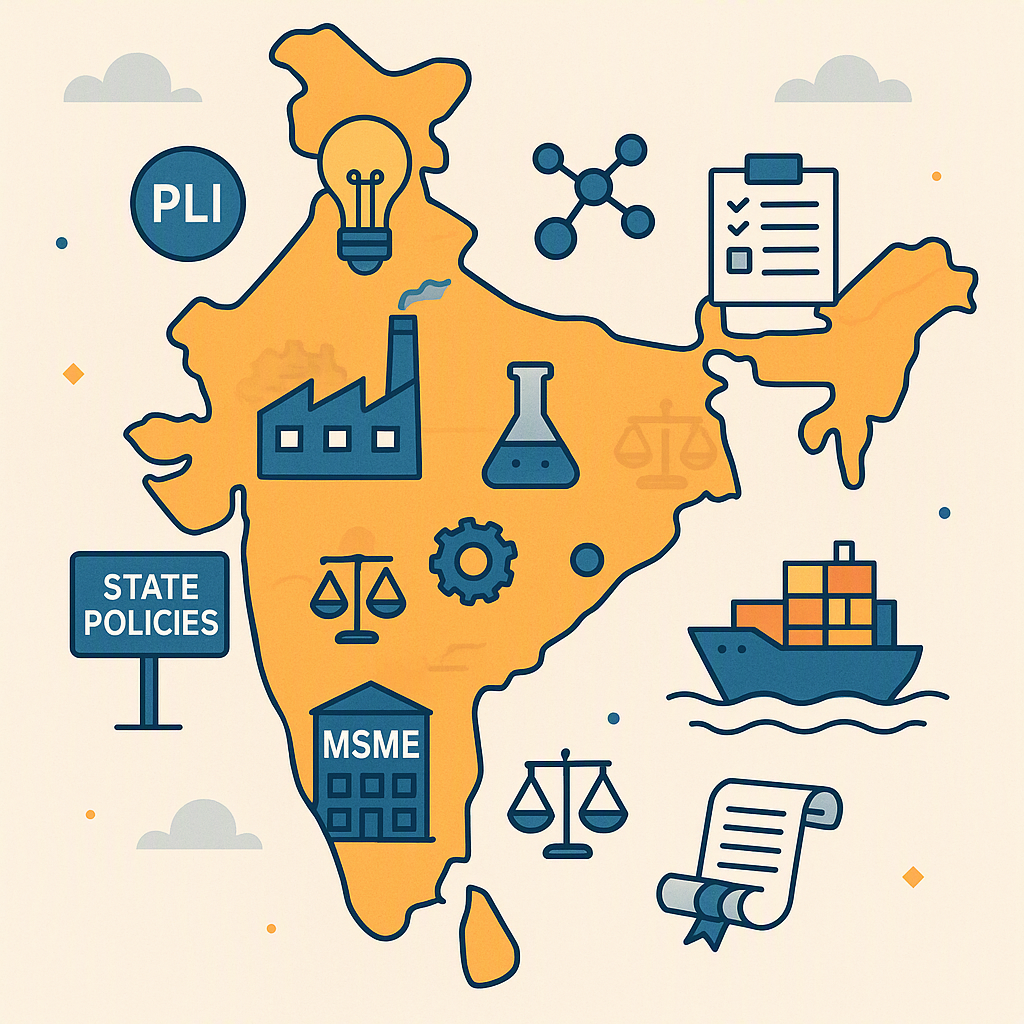
For every manufacturing unit or MSME, there are potentially two layers of subsidies: Central Government schemes (like PLI, DLI, or ISM) and State-level industrial policies. Each has its own rules, eligibility, and timelines. Figuring out what you qualify for is step one—and where most companies get stuck.
Actionable Tip:
Start by identifying whether your business goals align with Central schemes like the Production Linked Incentive (PLI) or State-specific programs like Gujarat Industrial Policy 2020. Use government portals like DPIIT or MSME websites to review eligibility criteria before contacting a consultant.
2. Stacking Schemes Is Complex
Did you know you can combine Central and State subsidies for the same project? Most companies don’t. But stacking only works if you structure your project and application correctly. Mess it up, and you’ll leave money on the table—or worse, get rejected outright.
Actionable Tip:
If you plan to stack schemes, ensure your documentation (e.g., project reports, investment breakdowns) is tailored to meet criteria for each scheme. A consultant can help you structure these details correctly to avoid conflicts.
3. Documentation Overload
Subsidy applications aren’t just about filling a form. You’ll need detailed project reports, cost workings, invoices, compliance certificates, government approvals—the works. And if your documents don’t meet the exact specifications? Expect delays or denials.
Actionable Tip:
Make a checklist of required documents for each scheme. For example, the PLI scheme may require incremental production figures, while State schemes may prioritize land-use compliance. Verify document formats (hard copy vs digital submission) to avoid rejections.
4. Deadlines Are Brutal
Many subsidy schemes have short, one-time application windows. Miss the deadline, and you’re out. Keeping track of these timelines while running a business? That’s a big ask.
Actionable Tip:
Create a subsidy timeline tracker for your business, listing application start/end dates, reporting deadlines, and renewal requirements. Apps like Trello or Asana can help manage multiple deadlines effectively.
A Real-World Scenario
Let’s break this down with an example. Say you’re setting up a manufacturing unit in Gujarat. You’ve heard about the Gujarat Industrial Policy 2020, which offers capital subsidies, SGST refunds, and other incentives. You’ve also heard about Central schemes like PLI (Production Linked Incentive), which could apply to your sector.
Here’s the problem: the Gujarat policy has different incentives for different zones (developed, developing, backward, etc.), and the PLI scheme has its own criteria like incremental sales targets. To qualify for both, you need to:
- Choose a location that maximizes State benefits while staying eligible for PLI.
- Structure your investment (land, machinery, etc.) so it meets the criteria for both schemes.
- Submit a detailed project report (DPR) with accurate projections for PLI.
- Meet specific deadlines for both applications—usually months apart.
Worked Method:
- Location Analysis: Use State zoning maps to identify areas with higher subsidy percentages.
- Investment Allocation: Break down your investment into categories that align with both schemes.
- DPR Preparation: Collaborate with experts to draft projections that match scheme guidelines.
Miss a step, and you could lose lakhs, if not crores, in potential subsidies. A consultant’s job is to make sure that doesn’t happen.
What Do Consultants Actually Do?
Good subsidy consultants don’t just fill out forms. Here’s how we (and others like us) help:
Eligibility Assessment
We start by mapping your project—sector, investment size, location—against all active Central and State schemes. Think of it as a subsidy feasibility study.
Scheme Stacking
If multiple schemes apply, we structure your project to maximize benefits. For example, claiming a capital subsidy at the State level and an export incentive at the Central level.
End-to-End Application
From DPR preparation to liaising with nodal agencies, we handle everything. This includes tracking deadlines, ensuring compliance, and managing submissions.
Post-Sanction Support
Once you’re approved, we help with utilization certificates, disbursement claims, and periodic reporting. Basically, we ensure you actually get the money.
Comparison Table: DIY vs Consultant
| Aspect | DIY Approach | Consultant Approach |
|---|---|---|
| Eligibility Analysis | High risk of missing schemes | Comprehensive mapping |
| Documentation | Time-intensive, prone to errors | Expert preparation |
| Deadlines | Easy to miss critical dates | Proactive tracking |
| Compliance | High risk of rejection | End-to-end support |
| Cost | Lower upfront cost | Higher ROI on subsidies |
Common Pitfalls to Avoid
We’ve seen companies lose out on subsidies for avoidable reasons. Here are some of the big ones:
1. Underestimating Timelines
Subsidy approvals can take months, even years. Start early.
2. Incomplete Documentation
Missing just one document can derail your application.
3. Assuming Eligibility
Just because your competitor got a subsidy doesn’t mean you’ll qualify. Every scheme has specific terms.
4. Ignoring Compliance
Post-sanction reporting is critical. Fail to comply, and your disbursement may be withheld.
The Bottom Line
Subsidies aren’t free money—they’re earned through careful planning, documentation, and compliance. And while you can navigate the system on your own, the margin for error is small. A good consultant isn’t a cost; they’re an investment in maximizing your benefits.
Need help figuring out what subsidies your business qualifies for? Get started with us →