Manufacturing Subsidies in India: Why It’s Hard to Get It Right
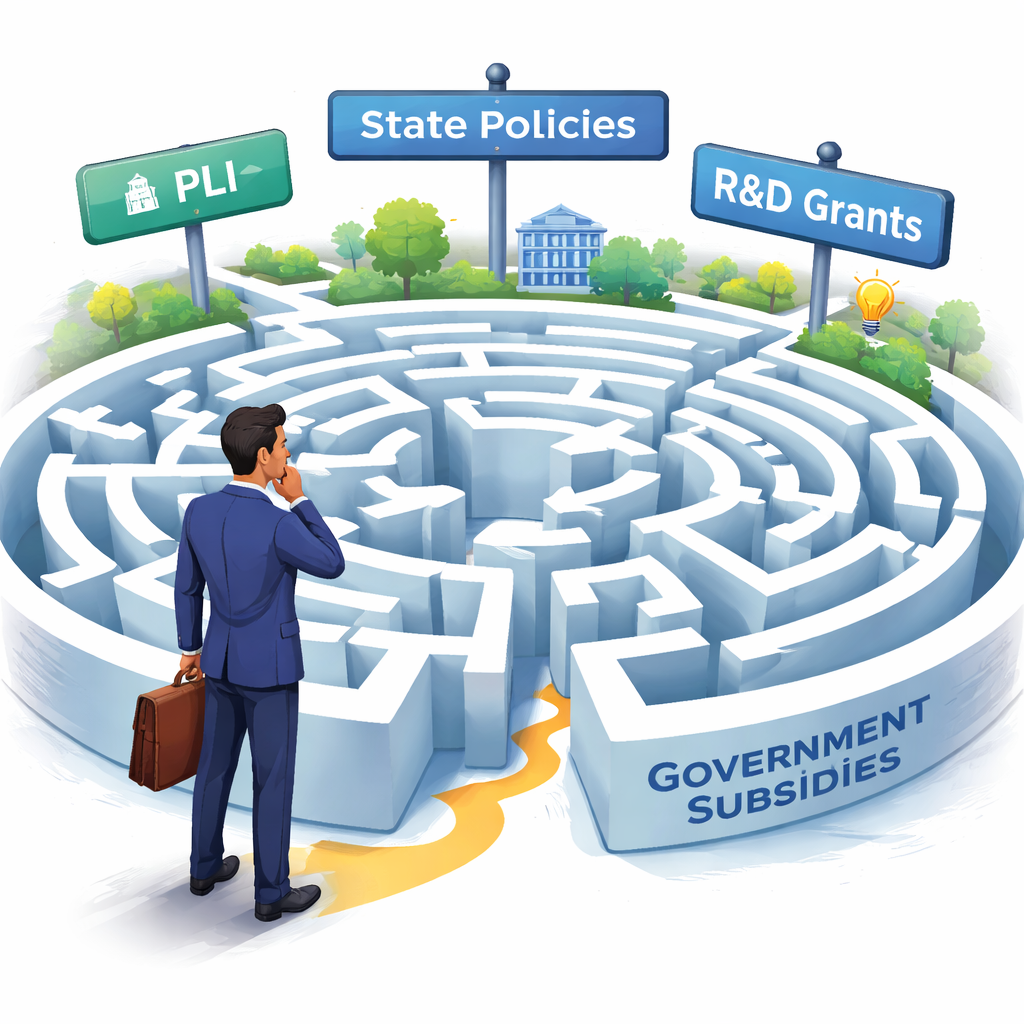
You’ve decided to set up or expand your manufacturing unit in India. Great decision. But if you’re here, you’ve probably realized how complex the government subsidy process can be.
The good news? India’s central and state governments have rolled out some incentives: capital subsidies, SGST refunds, interest subventions, and more. The bad news? Most businesses miss out because they either don’t know they’re eligible or can’t navigate the messy application process.
Let’s fix that. This guide will break down what you need to know about subsidy eligibility in 2026, how to assess your project’s chances, and how to avoid the pitfalls that lead to rejection.
Start With This: Not All Subsidies Are the Same
Here’s a reality check: subsidies aren’t free money. They’re not grants handed out for having a “good idea.” Subsidies are reimbursements for investments you’ve already made, tied to specific expenses like land, construction, and machinery.
For MSMEs (Micro, Small, and Medium Enterprises), they may extend to softer costs like IP filings or quality certifications. For larger units, you’re looking at SGST refunds, employment-linked incentives, or operational cost reimbursements.
And there’s a catch: central and state subsidies often have overlapping or conflicting criteria. It’s not as simple as applying for everything you see.
What Changed in Recent Years?
The landscape for manufacturing subsidies is always evolving. For example:
-
PLI (Production Linked Incentive) Scheme: Initially launched in 2020, the scheme now covers multiple sectors. However, it requires meeting specific production and sales targets to claim benefits.
-
State Industrial Policies: States like Tamil Nadu and Uttar Pradesh have revamped their policies in recent years (e.g., Tamil Nadu Industrial Policy 2021, Uttar Pradesh Industrial Investment Policy 2022) to attract more investments. Eligibility often depends on your location and project size.
-
Sector-Specific Schemes: Newer incentives target emerging sectors like semiconductors, EV manufacturing, and green energy. These often require aligning with national priorities like “Make in India” or “Atmanirbhar Bharat.”
To stay updated, regularly track updates on government portals like Make in India and state-specific platforms such as Invest India.
Navigating these changes while ensuring compliance with eligibility rules is half the battle.
How to Assess Your Eligibility
1. Understand the Basics
Before applying, you need to answer these questions:
- What type of subsidy are you eligible for? Central capital subsidy? SGST refund under a state policy? Something else entirely?
- What’s the size of your investment? Subsidy rates and benefits often vary depending on the scale of your project.
- Where is your unit located? Industrial zones in backward districts typically get preferential incentives in most state policies.
- What’s your sector? Certain sectors like electronics, textiles, and green energy are favored under both central and state schemes.
A clear understanding of these basics will help you identify which subsidies are worth pursuing.
2. Check Central and State Policies
Here’s where most businesses trip up. Central and state subsidies can (and should) be combined, but only if they’re compatible. For example:
- Central Schemes: These are uniform across India and often focus on specific sectors or activities, such as the PLI Scheme.
- State Policies: These vary based on the state’s priorities. For example, Tamil Nadu offers higher incentives for projects in southern districts under its 2021 policy. Uttar Pradesh’s 2022 policy emphasizes employment generation.
Pro Tip: Download the official policy documents from reliable sources like the Tamil Nadu Industrial Policy 2021 page or Uttar Pradesh’s investment portal. Don’t rely on summaries from third-party websites.
3. Evaluate Scheme Stacking
Can you combine a central capital subsidy with a state SGST refund? Often, yes. But it gets tricky. Some central schemes explicitly prohibit combining with other benefits, while others don’t.
Illustrative example — under certain schemes, combining central and state-level incentives may be allowed, provided the total doesn’t exceed a predefined cap. Always read the fine print to ensure compliance.
Use a decision framework like this to evaluate compatibility:
| Criteria | Central Scheme | State Scheme | Compatible? |
|---|---|---|---|
| Sector-Specific Eligibility | Yes | Yes | Usually Yes |
| Location-Specific Boosters | No | Yes | Depends on overlap |
| Restriction on Stacking | Explicitly Prohibited | Silent | Likely No |
| Total Cap on Incentives | 30% of Project Cost | 20% of Project Cost | Check Combined Limit |
4. Account for Compliance Requirements
Even if you tick all the eligibility boxes, your application can still fail if you don’t meet compliance criteria. Common missteps include:
- Missing Udyam registration for MSMEs.
- Failing to submit environmental clearance certificates for projects involving land acquisition.
- Incomplete project reports or financial statements.
- Not setting up a nodal officer to coordinate subsidy-related communications.
How to Prepare a Winning Application
1. Start With a Feasibility Report
Many businesses jump straight to filling out forms. Don’t. A solid feasibility report is your foundation. This should include:
- A detailed project cost breakdown (land, building, machinery, working capital).
- Employment projections (most state policies require this).
- Sectoral alignment (e.g., how your project fits into India’s broader industrial strategy).
2. Document Everything
Government agencies don’t take your word for it. Every claim you make needs to be backed by documentation, such as:
- Invoices and payment receipts for capital expenditure.
- Land ownership/lease documents.
- GST returns (for SGST refunds).
- Bank statements to validate cash flows and payments.
3. Work With Experts
Liaising with nodal agencies and navigating bureaucratic processes isn’t for the faint-hearted. Many businesses hire consultants to handle application preparation, filing, and follow-ups.
A good consultant can ensure you don’t miss deadlines or submit incomplete documents, which are common reasons for rejection.
Common Mistakes to Avoid
-
Assuming All Policies Are the Same Central and state schemes have different objectives. Don’t apply blindly.
-
Ignoring Deadlines Most policies have fixed application windows. Missing these means waiting another year.
-
Underestimating the Compliance Workload Even after your subsidy is sanctioned, you’ll need to submit utilization certificates, periodic reports, and disbursement claims. This isn’t a one-and-done process.
-
Skipping Pre-Application Consultations Many nodal agencies offer pre-application consultations to clarify doubts. Skipping this step often leads to incomplete applications.
FAQ: Manufacturing Subsidies in India
1. Can I apply for multiple subsidies simultaneously?
Yes, but only if the schemes are compatible. Review the terms of each scheme carefully to ensure no restrictions on stacking benefits.
2. What sectors are most likely to get subsidies?
Priority sectors in 2026 include electronics, textiles, semiconductors, green energy, and EV manufacturing.
3. What happens if my application is rejected?
Most policies allow you to reapply during the next cycle, but it’s critical to address the reasons for rejection. Consult with experts to fix errors.
4. Is hiring a consultant necessary?
Not mandatory, but highly recommended if you lack expertise in subsidy compliance or documentation. Consultants can save time and reduce errors.
5. How long does it take to get the subsidy approved?
Timelines vary by scheme and state. Central schemes can take 6–12 months, while state-level approvals may take 3–9 months.
Final Thoughts
Getting a government subsidy for your manufacturing business in India is no small feat. It’s a detailed, document-heavy process, but the rewards can be worth it if you do it right.
If you’re feeling overwhelmed, you’re not alone. Many businesses turn to experts for help. At Subsidy4India, we specialize in end-to-end subsidy advisory, from eligibility assessment to compliance support. Let’s make sure you don’t leave money on the table. Book a consultation →