
Understanding MSME Subsidy Schemes in India
When I started working with MSMEs years ago, I believed accessing government subsidies was straightforward. The government announces a scheme, you apply with the required documents, and voila — you get your funds. That’s what I told clients back then.
And why wouldn’t I think that? The brochures made it sound easy, and the nodal officers at government departments seemed helpful enough. The eligibility criteria were right there in black and white. Submit your project report, invoices, and a few forms. What could go wrong?
The Reality Check
Over time, I realized how complex the process really is. The schemes are intricate, the application process is often opaque, and even minor missteps can lead to missed opportunities. For instance, a missing certificate or an overlooked deadline can derail an application entirely.
This complexity is compounded by the fact that subsidy schemes in India frequently change, often with limited communication. Deadlines can appear and disappear without much notice. Rules vary not only by state but also by sector and sometimes even by district.
Why Is the Process Complicated?
Here are some specific reasons why MSME subsidy applications often feel overwhelming:
-
Frequent Policy Changes: Governing policies and scheme details can change annually based on budget allocations, policy reviews, and state priorities. Staying updated is not optional.
-
Inconsistent Communication: Government portals often delay updates and don’t notify stakeholders proactively about changes to deadlines or eligibility criteria.
-
Lengthy Documentation: Submitting the application is not just about filling out forms; you need to provide detailed project reports, financial statements, GST compliance reports, land ownership or lease documents, and even industry-specific permits.
-
Coordination with Multiple Departments: Often, a single scheme might require approvals or certifications from different government bodies, which adds layers of complexity.
-
Limited Awareness: Many MSME owners remain unaware of the full scope of subsidies available to them due to language barriers, lack of access to information, or the technical jargon used in the guidelines.
Why This Belief Lasted So Long
For a long time, I blamed the system. And to be fair, it is chaotic. But blaming the system didn’t help my clients. The real issue was my approach. I was treating it like a checklist when it’s more like a maze. You don’t just follow steps; you navigate obstacles. That’s not something the brochures tell you.
Common Misconceptions That Need to Change:
-
"Guidelines are enough": While the guidelines are the starting point, they rarely cover nuances like overlapping schemes, unspoken preferences of nodal officers, or local administrative practices.
-
"Deadlines are fixed": MSMEs often assume the deadlines are set in stone, but many schemes close early when funds are exhausted.
-
"It’s a one-time effort": The process doesn’t end with submission. Frequent follow-ups and clarifications with nodal officers are often required.
What We Do Differently Now
Here’s what changed. Instead of relying solely on published guidelines, we dig deeper. Below, I’ve broken down the key steps we take to improve the chances of success for MSMEs:
1. Eligibility Mapping
-
What We Do: We start every project with a detailed eligibility assessment. This involves matching the MSME’s profile (sector, size, location, and type of business activity) against the requirements of all applicable schemes — central, state, and district-level.
-
How You Can Do It:
- Check the official MSME portal (msme.gov.in) for national schemes.
- Visit your state government’s industry or MSME department website for local subsidies.
- Look for sector-specific schemes (e.g., food processing businesses may qualify under PMKSY).
2. Pre-Sanction Compliance Checks
-
What We Do: Before filing an application, we verify every required document against past approvals in similar cases. For instance, if a nodal officer rejected a claim last year over missing environmental clearances, we ensure that ours includes it upfront.
-
How You Can Do It:
- Prepare a checklist of required documents for each scheme.
- Consult government departments or experienced consultants to understand common reasons for rejection.
- Double-check all financial statements and ensure GST filings, tax returns, and bank statements are up-to-date.
3. Deadline Monitoring
-
What We Do: We maintain a calendar of application windows for every scheme we track. Since many schemes operate on a first-come, first-served basis, missing a deadline is not an option.
-
How You Can Do It:
- Use free tools like Google Calendar or Trello to track deadlines.
- Subscribe to updates from relevant government portals.
- Set reminders at least two weeks before a deadline to ensure timely submissions.
4. Scheme Stacking
-
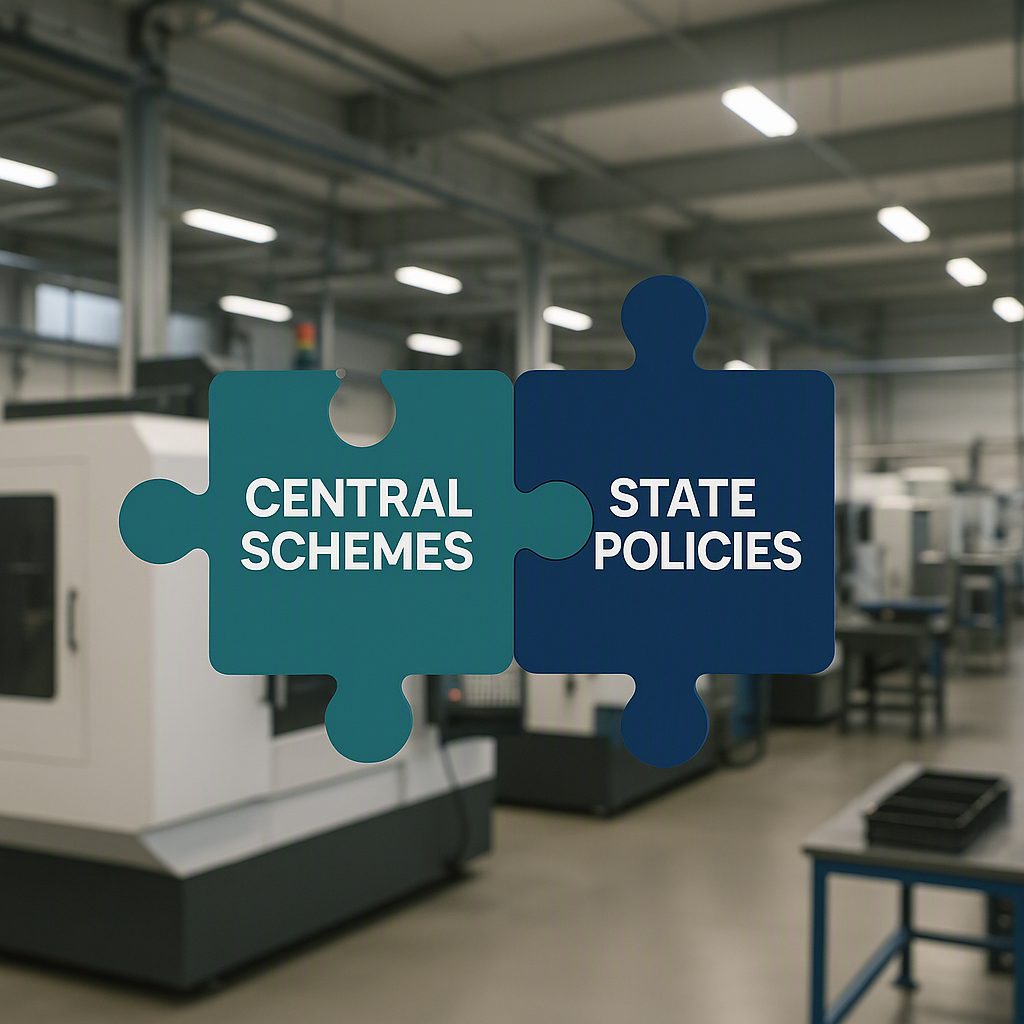
What We Do: Scheme stacking involves combining Central and State subsidies to maximize benefits. For example, a manufacturing unit might qualify for a capital investment subsidy under a central government scheme and an interest subsidy under a state-level industrial policy.
-
How You Can Do It:
- Carefully analyze eligibility rules for each scheme.
- Plan the project timeline to align with multiple subsidy windows.
- Consult a professional to avoid double-dipping, which could disqualify your application.
5. Building Relationships with Nodal Officers
-
What We Do: We don’t just submit applications — we engage directly with nodal officers to understand their expectations and keep track of any informal updates.
-
How You Can Do It:
- Attend MSME workshops and events where government officials are present.
- Visit the relevant department office in person, if possible.
- Establish a single point of contact within the department for follow-ups.
Comparison Table: Central vs. State Subsidies
| Aspect | Central Subsidies | State Subsidies |
|---|---|---|
| Scope | Nationwide | Limited to the specific state |
| Funding Limit | Generally higher | Typically lower |
| Application Process | Centralized and standard | May vary by state |
| Deadlines | Fixed, but funds may run out early | Often flexible but less predictable |
| Focus Areas | National priorities (e.g., export, innovation) | Local economic development |
Conclusion
If you're struggling to navigate India’s subsidy maze, you're not alone. Most MSMEs miss out simply because they don't have the right guidance. With the right approach — understanding eligibility, preparing documentation thoroughly, tracking deadlines, and leveraging both central and state schemes — you can maximize the benefits available to your business and ensure you don’t leave money on the table.
Subsidies are not just about free money; they are catalysts for growth. By treating the application process as a strategic investment rather than a bureaucratic hurdle, you can position your business for long-term success.