
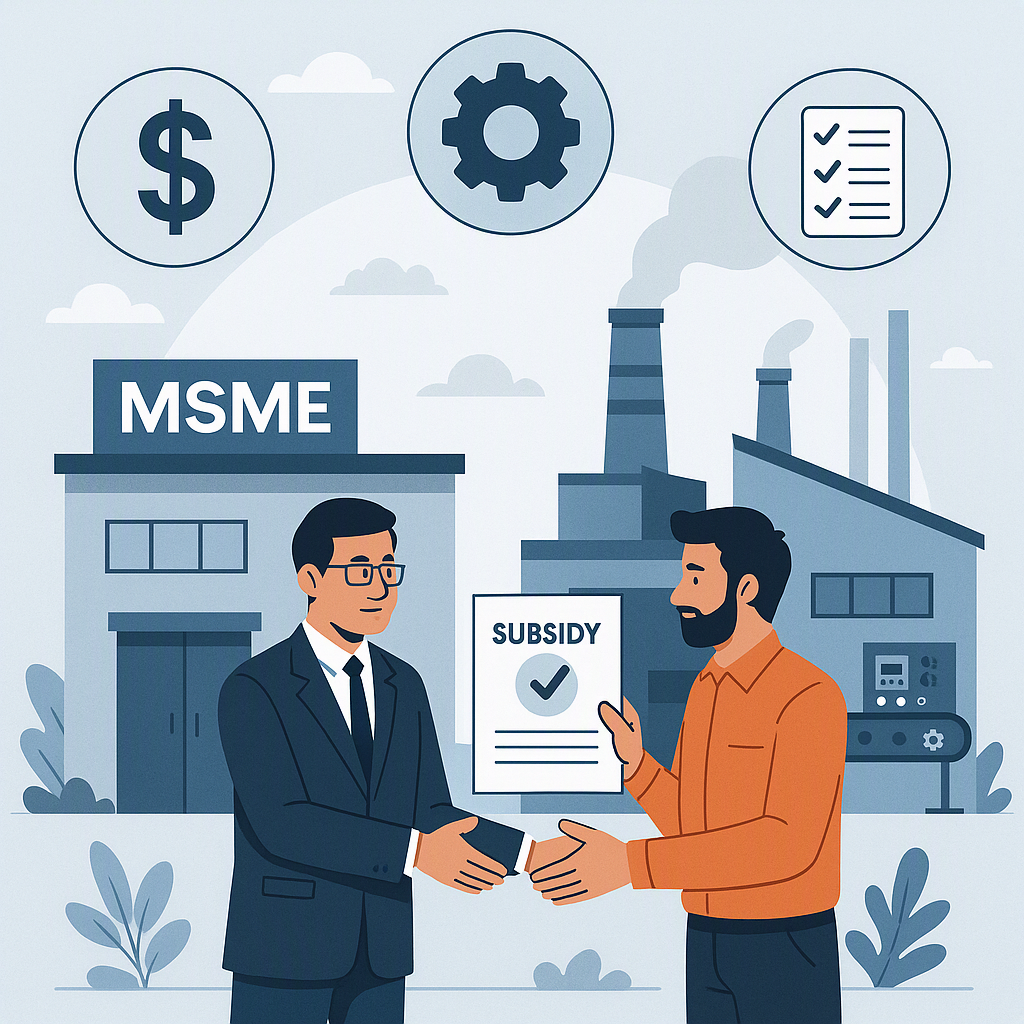
Why MSMEs Miss Out on Subsidies (And How You Can Avoid the Same Mistakes)
Let’s start with a hard truth: most MSMEs in India don’t maximize the subsidies they’re eligible for. Some don’t apply because they don’t even know what’s available. Others try to apply but get stuck in bureaucratic quicksand—missing deadlines, submitting incomplete documents, or making errors that lead to rejections. And let’s be honest, navigating government portals and policies isn’t exactly intuitive.
But here’s the thing: these subsidies can make or break a business. Whether it’s a capital subsidy that offsets your machinery costs or an interest subvention that takes the sting out of a business loan, these benefits are real and tangible. The challenge is figuring out how to access them. That’s where most MSMEs stumble.
The Two Big Myths About Subsidies
Let’s clear up some misconceptions first. These are the two biggest myths I’ve encountered while working with MSMEs:
-
“Subsidies are just free money.”
They’re not. Subsidies are reimbursements tied to actual investments or expenditures. You need to spend first, document everything, and then present a compelling case to the government to get your money back. It’s not a handout—it’s earned.Actionable Tip: Before committing to a subsidy, review its terms thoroughly. Understand what qualifies as reimbursable expenses and ensure you have the financial capacity to bear the upfront cost, as the subsidy will come later.
-
“Every company gets the same benefits.”
Not true. The benefits you can claim depend on several factors: your location, industry, project scale, and even which taluka or development zone your operations fall into. For instance, an MSME in a backward district might qualify for higher benefits compared to one in a developed area.Actionable Tip: Use government resources like district-level industrial development offices or online portals to verify your eligibility. These agencies often release maps and charts showing the zones eligible for higher benefits.
The Real Problem: Complexity
Let’s talk about why claiming subsidies is so hard. The landscape is a mess. There are numerous active schemes from Central and State governments, each with its own eligibility criteria, application forms, and compliance requirements. Some are sector-specific, while others are broader. Add to this the fact that these schemes are updated—or altogether replaced—every few years, and you’ve got a recipe for confusion.
Here’s an example. Say you’re an MSME setting up a manufacturing unit in a state like Gujarat. You might be eligible for:
- Capital investment subsidy under the state’s industrial policy.
- Interest subvention on your term loan.
- SGST reimbursement on incremental sales.
- Central benefits if you’re in a priority sector like electronics or pharmaceuticals.
Sounds great, right? But figuring out how to combine these benefits without violating the terms of one or the other is where things get tricky. Many MSMEs leave money on the table because they don’t know that Central and State schemes can often be stacked.
A Practical Example: Capital Subsidy
Let’s focus on just one type of subsidy: capital subsidy. It’s simple in theory—a percentage of your project’s fixed capital investment is reimbursed. But the devil is in the details.
First, you need to understand what counts as “fixed capital investment.” Typically, this includes:
- Land (sometimes capped at a certain percentage of total investment).
- Building construction.
- Plant and machinery (but not second-hand equipment).
Next, you need to document everything meticulously. Invoices, payment proofs, project reports—these aren’t optional. And here’s the kicker: if your paperwork doesn’t match the scheme guidelines exactly, your claim may be rejected or delayed indefinitely.
Actionable Steps to Claim a Capital Subsidy
- Break Down Your Investment: Categorize your project costs into land, building, machinery, etc., and ensure they align with the subsidy guidelines.
- Verify Machinery Eligibility: Check if the machinery you plan to purchase qualifies under the scheme. Some subsidies exclude imported or second-hand equipment.
- Prepare Financial Documentation: Collect and organize invoices, bank statements, and payment proofs for every expenditure.
- Hire a Consultant if Needed: A subsidy consultant can help you ensure compliance with scheme requirements and expedite the application process.
Common Mistakes MSMEs Make
Here are some of the most common pitfalls we see:
-
Applying for the wrong scheme.
Not every scheme is a fit for every business. If you apply for a scheme you’re not eligible for, you’re wasting time and resources.Solution: Research thoroughly or consult government helplines or experts to confirm suitability before applying.
-
Incomplete documentation.
The government doesn’t take your word for it. If you can’t back up your claims with proper documentation, your application is dead on arrival.Solution: Use an organized checklist to ensure all required documents are included, such as project reports, invoices, and tax filings.
-
Missing deadlines.
Many schemes have specific windows for application. Miss it, and you’re out of luck until the next cycle—if the scheme is still around.Solution: Set calendar alerts or use project management tools to track deadlines.
-
Poorly structured projects.
If your project isn’t designed to align with the scheme’s objectives, you’re unlikely to get approval. For instance, a capital subsidy scheme might prioritize projects in renewable energy or waste management. If your project doesn’t fit the narrative, it won’t make the cut.Solution: Tailor your project’s objectives to match the goals of the subsidy program.
What Can You Do Differently?
So, how do you avoid these traps? Here’s what I recommend:
-
Start with an eligibility assessment.
Before you fill out a single form, figure out which schemes you qualify for. This depends on your sector, location, and project details. A feasibility report or one-pager summarizing your options can save you weeks of wasted effort.Pro Tip: Use online tools like the MSME Sampark Portal to explore applicable schemes.
-
Get your documentation in order.
This isn’t the time to cut corners. Invest in professional help if needed. A well-prepared application is your best shot at approval.Pro Tip: Consult industry associations, which often provide document templates and reviews.
-
Think about scheme stacking.
Don’t settle for just one subsidy. Explore how Central and State schemes can complement each other to maximize your benefits. For example, a capital subsidy from the State can often be combined with SGST reimbursement or Central incentives.Pro Tip: Contact industry-specific boards (like the Electronics Development Fund for electronics companies) to understand sector-specific stackable benefits.
-
Monitor deadlines religiously.
Set up reminders for application windows, compliance reporting, and disbursement claims. Missing a deadline can cost you significant benefits.Pro Tip: Join WhatsApp groups or mailing lists managed by government agencies or industrial bodies. They often share updates on upcoming deadlines.
FAQ: Answering Common MSME Questions
Q: Can subsidies cover working capital needs?
A: Not usually. Most subsidies are tied to fixed capital investment. However, exceptions like interest subvention schemes can reduce the cost of working capital loans.
Q: How long does it take to get disbursement?
A: It varies widely. Central schemes can take months—or even years. State schemes are often faster but still require consistent follow-ups. Delays often occur due to incomplete documentation or non-compliance.
Q: Can I apply for multiple subsidies at once?
A: Yes, but you need to ensure compliance with each scheme’s guidelines to avoid conflicts. Consult with a subsidy specialist to structure your project accordingly.
Q: Are startups eligible for MSME subsidies?
A: Many subsidies are designed for MSMEs, including startups. However, ensure your startup is registered as an MSME and meets the relevant turnover or investment criteria.
Q: Do I need to repay subsidies if my project fails?
A: Non-compliance with scheme terms can lead to penalties or clawbacks. Always review the terms carefully before accepting funds.
Decision Framework: Choosing and Applying for Subsidies
| Criteria | Steps to Consider | Example |
|---|---|---|
| Sector | Check if your industry is eligible for sector-specific schemes. | Renewable energy projects often qualify. |
| Location | Verify if your district/taluka is in a notified development zone. | Backward areas often get higher subsidies. |
| Project Size | Ensure your project falls within the investment limits specified by the scheme. | MSMEs with small budgets may qualify easier. |
| Compliance | Review all documentary and regulatory requirements beforehand. | Maintain clear records of all transactions. |
Final Thoughts
MSME subsidies are worth the effort, but they’re not easy money. They require planning, compliance, and a solid understanding of the rules. If you’re serious about maximizing your benefits, don’t go it alone.
Need help navigating the subsidy maze? Subsidy4India specializes in end-to-end subsidy advisory for MSMEs and large industrial units. Let’s make sure you don’t leave money on the table.