
Why Documentation Matters for Subsidy Applications
Let’s start with a harsh truth: most subsidy applications fail because of bad paperwork. I’ve seen it happen too many times. A missing invoice, an improperly formatted Detailed Project Report (DPR), or even a simple typo in your GST certificate can delay your application by months—or worse, get it rejected outright.
Subsidies aren’t free money. They’re reimbursements tied to your investment, and the government needs proof. Solid documentation isn’t just bureaucracy—it’s your ticket to approval. For example, the Indian Ministry of Food Processing Industries (MoFPI) mandates specific requirements such as an Aadhaar card and a landholding certificate for individual farmers looking to apply for subsidies under their schemes (MoFPI.gov.in). Missing these essential documents will likely lead to rejection.
So, if you’re an MSME planning to expand your operations, here’s what you need to know to get your paperwork right the first time.
Central Government Schemes: Document Requirements
Central schemes like the Production-Linked Incentive (PLI) or the Design-Linked Incentive (DLI) have uniform eligibility requirements nationwide. But that doesn’t mean the documentation is simple. Here’s a typical checklist based on publicly available guidelines:
- DPR (Detailed Project Report): This is your business blueprint. It must cover your project’s objectives, capex details, technology plans, and projected financials. Without a well-prepared DPR, your application won’t even make it to the review stage. As noted by Subsidy4India, the DPR is non-negotiable and should be tailored to align with the specific requirements of the subsidy scheme.
- Investment Proofs: Include invoices, payment receipts, and bank statements for every eligible expense—land, building, plant, machinery. As per the MoFPI document checklist, these proofs are critical for validation and should be neatly organized and labeled.
- Identity Proofs: Aadhaar and PAN cards for promoters and directors. Make sure the copies are clear and up-to-date. For example, applications under PM Awas Yojana require both Aadhaar and PAN cards as mandatory documents (ICICI Housing Finance).
- Incorporation Documents: For MSMEs, this means your Udyam Registration Certificate. For larger units, it’s your Certificate of Incorporation. As outlined by My Startup Solution, this document is critical and should be up-to-date.
- GST Registration Certificate: Non-negotiable for tax-related incentives. Double-check the details for any spelling or numeric errors.
- Bank Details: A cancelled cheque or a passbook copy to verify the account where the subsidy will be credited. Ensure the account matches the name on the application.
Pro Tip: Ensure your DPR aligns with the scheme’s specific guidelines. For example, if applying under PLI, emphasize your incremental production output. Don’t recycle a generic DPR—it won’t cut it.
Additionally, consult the latest circulars or guidelines issued by the scheme authority. They often include specific formatting requirements for documents like DPRs or bank statements.
State Government Schemes: What’s Different?
State-level industrial policies vary widely. What works in Maharashtra may not apply in Tamil Nadu. For instance, Tamil Nadu requires applicants for capital subsidies to submit their Udyog Aadhaar Memorandum and partnership deeds for partnership firms (MSME Online). Here’s what to watch for:
- Location-Specific Documents: Some states classify areas by zones (e.g., backward, industrial, urban). You’ll need proof of your unit’s location—electricity bills, lease agreements, or property tax receipts. Ensure these documents are dated and match the application timeline.
- Development Permissions: If you’re setting up in a Special Economic Zone (SEZ) or a designated industrial cluster, include the SEZ approval letter or cluster registration. This is often overlooked but critical for eligibility.
- Stamp Duty Reimbursement Proofs: States like Gujarat and Karnataka often reimburse stamp duties on property purchases. Keep those receipts handy and ensure they are stamped and signed.
- Power Tariff Subsidy Docs: Electricity bills and payment proofs are a must if you’re applying for power cost subsidies. Double-check for consistency in billing names and addresses.
Pro Tip: State schemes often have shorter application windows than Central ones. Missing a deadline means waiting another year—if the scheme even gets renewed. Track these windows closely.
Also, states have unique eligibility criteria tied to local priorities, like backward area development or employment generation. Study these criteria carefully before applying.
Preparing a Detailed Project Report (DPR): A Step-by-Step Guide
The DPR is the backbone of your subsidy application. It’s where most businesses stumble. Here’s a practical breakdown:
- Executive Summary: Keep it crisp but impactful. Highlight your project’s scale, objectives, and alignment with the subsidy scheme. Avoid jargon and focus on measurable outcomes.
- Project Cost: List every expense—land, civil works, machinery, tech upgrades. Use real invoices or vendor quotes, not estimates. Categorize costs clearly to avoid confusion.
- Revenue Projections: Show how the investment will pay off. Include projected sales, SGST contributions, and employment generation. Use conservative but realistic numbers to build credibility.
- Technology Details: If you’re upgrading, explain the tech’s impact on efficiency, output, or quality. Include diagrams or specifications where possible.
- Compliance Section: Address how your project meets the scheme’s environmental, zoning, and tax compliance requirements. Add supporting documents like NOCs or approvals where needed.
Pro Tip: Many applications fail because the DPR is too vague or doesn’t justify the investment. If you’re not confident, hire a consultant who knows the ropes.
Investment Proofs: What You Need and How to Prepare
Investment proofs are another pain point. The government doesn’t just take your word for it—they need evidence. Here’s what works:
- Invoices: Must include vendor details, GST numbers, and item descriptions. Avoid handwritten invoices unless explicitly allowed.
- Payment Receipts: Show proof of payment—cheque numbers, UTR references, or bank statements. These should match the amounts mentioned in the invoices.
- Bank Statements: Attach six months of statements to verify fund transfers for capex. Highlight relevant transactions for clarity.
- Land Purchase Docs: Sale deeds, registration papers, and stamp duty receipts. Cross-check for consistent property details.
- Machinery Imports: Include bills of entry and customs duty payment receipts if applicable. For instance, the MoFPI requires these for capital subsidy applications (MoFPI.gov.in).
Common Mistake to Avoid: Submitting incomplete or mismatched documents. If your invoice says ₹10 lakh but your bank statement shows only ₹9.5 lakh, explain the gap (e.g., TDS deduction).
Compliance Documentation for Post-Sanction Monitoring
Approval is just the beginning. To actually receive the funds, you’ll need to comply with a laundry list of conditions. Here’s what to prepare:
- Utilization Certificates (UCs): These confirm that the funds were used for the approved purposes. They must be signed by a Chartered Accountant (CA).
- Periodic Progress Reports: Some schemes require you to report project milestones—like machinery installation or production start dates. Use a standard format provided by the scheme.
- Employment Records: If your subsidy is tied to job creation, maintain payroll records and employee EPFO/ESIC details. Keep these records updated monthly.
- Tax Payment Proofs: For tax refunds or SGST reimbursements, submit GST returns and tax deposit receipts. Ensure no discrepancies between claimed amounts and reported figures.
Pro Tip: Assign someone in your team to handle compliance. This isn’t a one-time task; you’ll need to monitor and report regularly. Missing post-sanction requirements can lead to fund withdrawal or penalties.
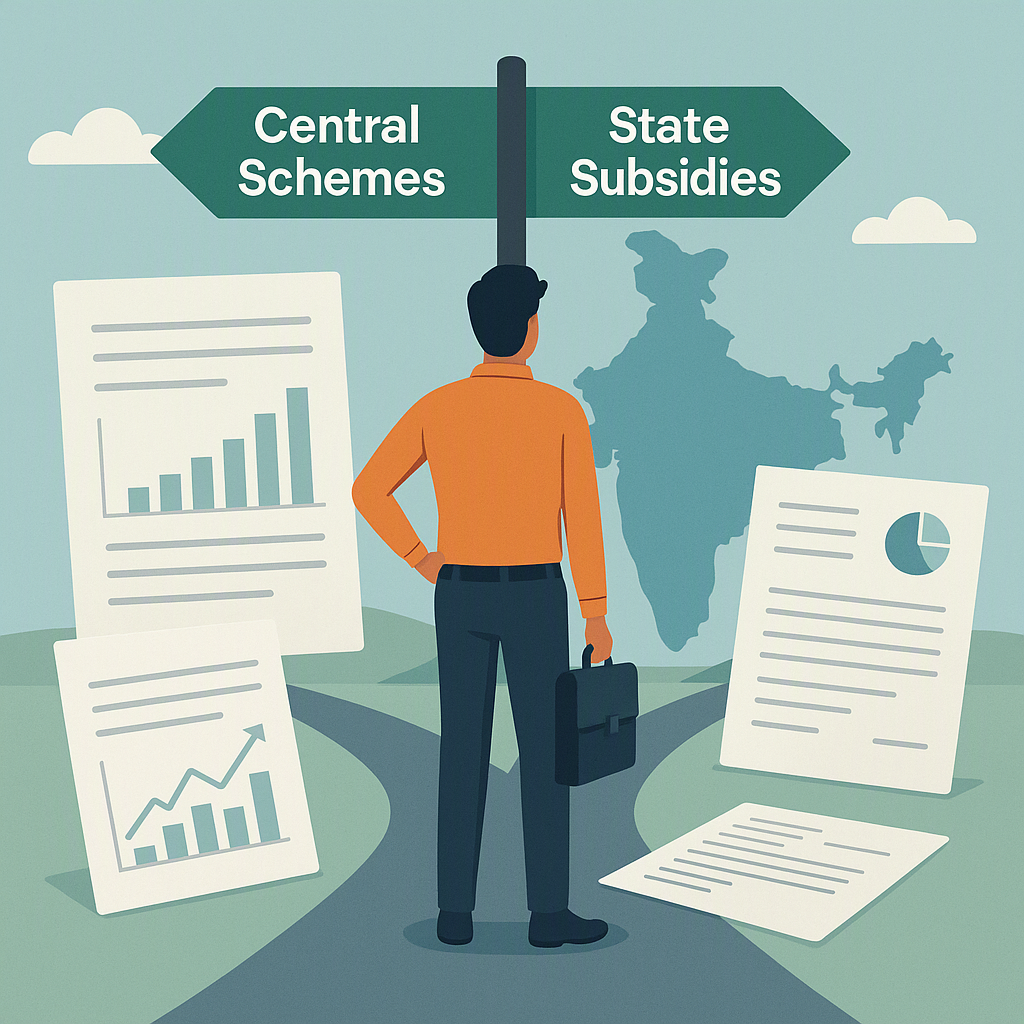
Maximizing Benefits: Combining Central and State Subsidies
Many MSMEs leave money on the table by not stacking schemes. But this requires careful planning, especially with documentation. Here’s how to do it right:
- Map Eligible Schemes: Start with a clear picture of all applicable Central and State schemes. For instance, layer a Central capital subsidy (e.g., CLCS-TUS) with a State-level interest subvention scheme.
- Avoid Redundancies: Some documents, like the DPR, can serve multiple applications if tailored well. Reuse, but don’t copy-paste. Minor adjustments for each scheme can save time.
- Sync Timelines: Ensure the application timelines align. If a State subsidy requires prior approval before applying for a Central scheme, don’t miss that step.
Pro Tip: Be transparent. If you’re applying for multiple subsidies, disclose it. Governments often cross-check for double-dipping.
Common Mistakes (and How to Avoid Them)
- Skipping Pre-Approvals: Some subsidies require you to get approval before starting the project. Starting without it makes you ineligible.
- Inconsistent Data: Mismatched project costs, incomplete signatures, or missing annexures can derail your application.
- Ignoring Updates: Scheme guidelines change frequently. Always check for the latest version before submitting.
Comparison Table: Central vs State Subsidies
| Criteria | Central Schemes | State Schemes |
|---|---|---|
| Eligibility | Uniform nationwide | Varies by state, often zone-specific |
| Application Deadlines | Longer windows (6-12 months) | Shorter windows (3-6 months) |
| Focus Areas | Scale and production output | Local development and job creation |
| Documentation Complexity | High | Moderate |
| Post-Sanction Compliance | Extensive | Moderate |
If you’re struggling to navigate the subsidy maze, we can help. Our team specializes in identifying, applying for, and securing subsidies for MSMEs and large units. Let’s get started →